
What made South Africa so suspicious? Well, there was a strange request by the Australian camp before the series began to turn down the volume on the stump mics. The inference was that the tourists were planning a confrontational approach in the middle, but the request was a “surefire way of making sure it stays turned up”, one commentator later told The Australian. It put the entire broadcast booth on alert.
Then there was the devastating swing Australia’s bowlers generated during the first Test in Durban, when Mitchell Starc had the ball on a string. There was no evidence Australia had tampered, but something didn’t feel right to South Africa captain Faf du Plessis, and for the rest of the series he kept a pair of binoculars in his bag.
The swing also troubled a camera operator for South African network SuperSport. He had spent a lot of time watching cricket in Durban and had rarely seen a ball reverse so early in such benign conditions. He told the broadcast director, Alvin Naicker, about his doubts.

Mitchell Starc ripped through South Africa to win the first Test in Durban (Getty)
But perhaps the red flag was in David Warner’s hand. Australia’s vice-captain wore heavy bandaging on his thumb, index finger and palm while fielding on day two of the second Test in Port Elizabeth. Some South African batters were said to have raised concerns with the umpires about his handling of the ball.
Warner’s bandages became a major talking point over the next 48 hours, so much so that his former teammate Ryan Harris appeared on TV to defend him. “The time I played with Davey, he had all that strapping on his fingers,” Harris told Channel Nine. “Unless there’s something rough – sand or glass or something – on that taping, it’s not going to do anything to the ball.”
By now the South Africans – players, coaching staff, commentators, pundits, fans, online sleuths – were suspicious of their visitors. The Australians sensed this. But what they didn’t realise was quite how invested Naicker’s TV crew were in finding a smoking gun.
It was 1-1, tensions were running high, and by the time the teams reconvened in Cape Town for the third Test, there would be cameras trained on Australia’s every move.
Best of enemies
Hatred might be too strong a word. After all, plenty of players on both sides had been teammates in franchise cricket and shared a grudging respect. But Australia and South Africa already had a strained history, and once the series started started they became positively hostile.
The friction could be traced back to a bitter three-Test series in 2014 when Australia hit South Africa with “the most abuse we’ve had on the cricket field,” according to AB de Villiers. Dale Steyn had accused the Australians of “bullying” and Du Plessis described them as “a pack of wild dogs”. In response, the Australians barked at Du Plessis when he came out to bat.
Then, in 2016, Du Plessis was caught ball-tampering using the fluid from a mint on his tongue. He was fined a full match fee, and South Africa won another fractious series 2-1.
So when Australia touched down in Durban two years later, they did so amid simmering animosity. It boiled over on day four of the first Test when Warner ran out De Villiers for a first-ball duck. Nathan Lyon whipped off the bails before needlessly chucking the ball down on De Villiers lying prone on the ground, while Warner taunted his batting partner Aiden Markram over the crucial wicket.
It signalled Australia’s intent to be horrible opponents. Starc and Josh Hazlewood were ruthless with the ball and their teammates were relentless in the middle, chirping away in every batsman’s ear. “It annoyed me to such an extent I had to turn my stump mic down,” commentator Mike Haysman later recalled.
South Africa were not saints, either. Later that day, as the players left the field for tea, Quinton de Kock allegedly made a derogatory comment about Warner’s wife Candice. More than a decade earlier, Candice had been photographed in a toilet cubicle with the New Zealand rugby player Sonny Bill Williams, and their tryst had been the subject of personal barbs. A furious Warner had to be held back in the stairwell to the changing rooms as players from both sides swarmed into the melee, including a half-naked Du Plessis clinging to a towel.
Australia won the first Test by 118 runs. “This series will be one to remember,” De Villiers posted on Twitter the next morning, and it would prove prophetic.
On day one of the second Test in Port Elizabeth, two Cricket South Africa officials were pictured grinning for photos with a group of fans wearing masks of Bill Williams’ face. The Australians were furious – Warner’s wife and children were in the stands – and Cricket South Africa was forced to issue an apology.

Kagiso Rabada speaks to the media to explain his confrontation with Steve Smith (Getty Images)
On the same day, Kagiso Rabada clashed with Steve Smith, celebrating in the face of his rival and bumping shoulders after taking his wicket. Rabada was handed a two-match ban which was later controversially overturned amid feverish debate.
Match referee Jeff Crowe wrote in an ICC report of the incident: “Never in my 14 years of refereeing have I seen such animosity between two teams.”
Caught on camera
Australia batted first in Cape Town and were bowled out for 255 early on day two. As they took to the field, the local camera operators were watching the Australians closely. The bowler, the slips, the man stationed at cover – anyone who handled the ball on its journey back across the field was under surveillance, and soon the cameras honed in on Cameron Bancroft.
At around 2.20pm, one SuperSport operator captured the fatal footage of Bancroft working the ball in his hands. Realising they’d found something seismic, the director Naicker decided to play the replays on his broadcast.
Separately, the Newlands Stadium operator put the same footage on the big screen inside the ground. There was no obligation to do so, but they wanted to provoke a reaction with a strategic disclosure of evidence, shaking the tree to see what fell.
The atmosphere quickly turned toxic. Loud jeers filled the air. Australia panicked. Head coach Darren Lehmann got on the walkie-talkie to 12th man Peter Handscomb down on the boundary, who dashed onto the field between overs to alert Bancroft.
Realising the grift was up, Smith told Bancroft to stash the sandpaper down his trousers. There was the irrefutable proof, filmed in 150 frames per second: Bancroft gently loosening his drawstring, opening his waistband, pulling the contraband from his pocket and stuffing it inside.

Cameron Bancroft pulls out the sandpaper from his pocket before dropping it in his trousers (SuperSport)

Bancroft is confronted by the umpires as Smith listens in (Getty)
A rare quiet fell across Australia’s Fox Sports booth as the team watched the slow-mo replay of Bancroft reaching into his pocket on their TV screens. As his hand emerged, with the yellow flash of sandpaper visible between his fingertips, the realisation of what was happening quickly dawned. “Oh no,” came a familiar Melbourne drawl, piercing the silence. Shane Warne was always a beat ahead of the rest.
There was something about the yellow paper, incongruous with the surroundings, conspicuous in its vibrant colour. This was clearly a foreign object, something alien to the cricket field, and the only possible conclusion was that this was not some impromptu ruse but cold-blooded cheating, with a plot and conspirators.
The fallout
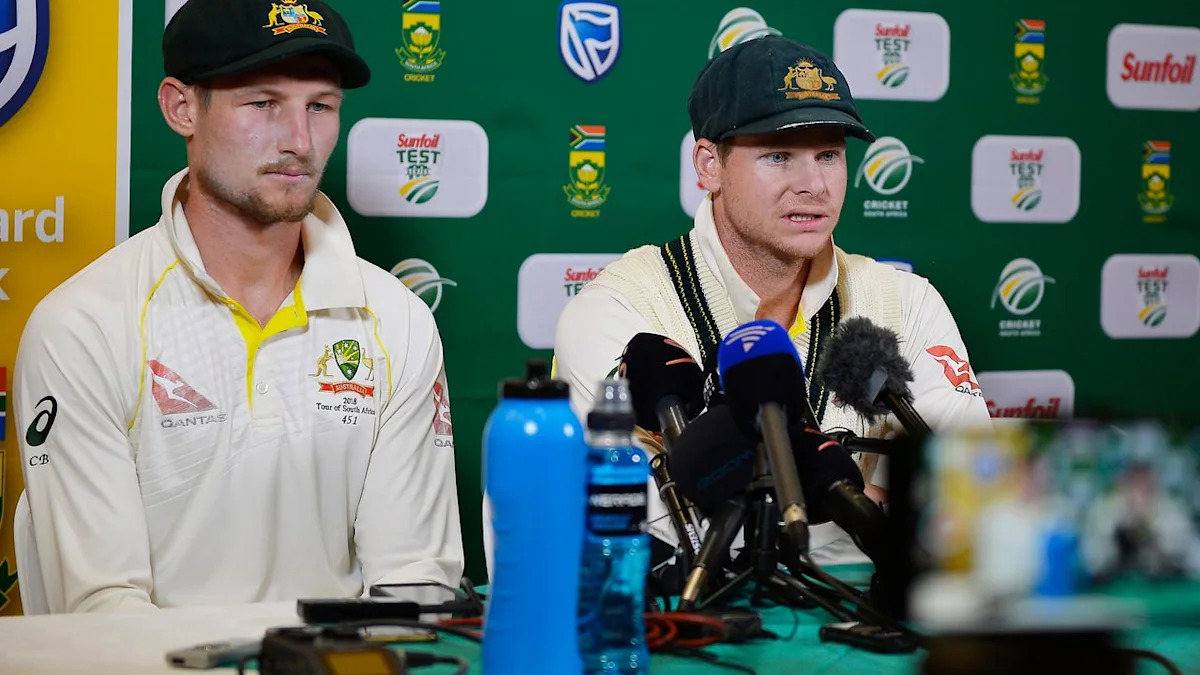
An hour after the close of play, Smith and Bancroft emerged from the Australian changing room to face the music. It was a PR strategy designed to nip the story in the bud, but their obfuscation only made the situation worse. Bancroft claimed he’d used sticky tape and some granules of dirt to rough up the ball, which was a lie. Smith said an unspecified “leadership group” had concocted the plan at lunch. He apologised but insisted he would stay as captain.

Bancroft and Smith speak to the media at the end of day three in Cape Town (Getty)
Perhaps had this been just another story of players picking at the seam or applying vaseline to the lacquer, it would have washed away in a week’s news cycle. When Du Plessis went through his own tampering scandal in 2014, Smith had spoken up in his defence by insisting such little tricks were commonplace in the game, and it was a relatively brief episode. The South African captain even sent Smith a text message after the events in Cape Town reassuring him that the storm would pass.
But what was so unusual, and gripping, about sandpapergate was the damning footage of deceit, and of someone clumsily trying to conceal it. When Ben Johnson doped to win Olympic 100m gold in 1988, he was not caught for three days. It took years to bring down Lance Armstrong. Match-fixing scandals and state-sponsored doping require investigations, evidence, hearings, judgements. Whereas Australia were caught in the act, an act beamed to the world in high definition.
And, of course, this wasn’t any old village side but the Australian cricket team, an iconic sporting institution as synonymous with greatness as the All Blacks or Brazilian football. In the days that followed there was shock, shame and schadenfreude. Cricket Australia CEO James Sutherland announced an investigation. Prime minister Malcolm Turnbull despaired, saying: “How can our team be engaged in cheating like this? It beggars belief.”
The press didn’t hold back. The Australian ran the headline “Smith’s shame” on its front page the next morning. Respected sports writer Patrick Smith lambasted the “earthquake of arrogance” at the epicentre of the scandal. The Darwin tabloid NT News later won an award for its headline: “Why I’ve got some sticky near my dicky,” beside a picture of Bancroft reaching into his trousers.
Who knew?
The overriding question in the aftermath was: who knew? Three days later, once Australia had collapsed to a shambolic defeat, the investigation found Warner was the instigator and he enlisted Bancroft to carry out his dirty work. Smith was supposedly the only other person who knew about the plan, and he did nothing to stop it. Cricket Australia banned Bancroft from cricket for nine months; Warner and Smith were banned for 12 months.
Despite global outrage over the incident, they were widely interpreted as harsh punishments, designed largely to show Cricket Australia’s strength. There was also the sense that we still didn’t know the whole truth. The Australian bowlers really had no idea how their ball was being managed? Experienced fellow cricketers found that hard to believe, but Starc and the rest of the bowling unit have always insisted they were in the dark.
In the closest thing to a clear answer, Bancroft later told the Guardian: “Obviously what I did benefits bowlers and the awareness around that, probably, is self-explanatory.” When pressed whether he meant the bowlers knew about the tampering, Bancroft added: “Uh … yeah, look, I think, yeah, I think it’s pretty probably self-explanatory.”

Bancroft is confronted by umpires on the field (Getty)
Australia’s back-up spinner on the tour, Jon Holland, recently said Smith, Warner and Bancroft were “hung out to dry”.
“Once we got back to the hotel we did sit as a group [to discuss] what had happened and who was going to take the blame,” Holland told The Australian. “To Davey’s credit, from what I remember, he did put his hand up and say he would take some of the responsibility, but not all of it. To be sitting there and seeing three blokes hung out to dry when you are supposed to be part of a team was a pretty hard watch.”
Lehmann discovered the scandal with everyone else, as it unfolded on the big screen. The head coach initially stayed on, but later said his family had received such abuse back in Australia that he had no choice but to resign in order to protect them. He wiped away tears as he called on the nation to support his players.
Another burning question remained unanswered: had this happened before? Was this really the only game – the only session, according to Smith – in which Australia tampered? Joe Root was asked whether he suspected they cheated during the Ashes a couple of months earlier and said he didn’t think so. In fairness, Australia could have bowled with a tennis ball and still won that series.

Steve Smith breaks down in tears as his father stands by his side (Getty)

David Warner and his family are met by waiting press at Sydney Airport (Getty)
Smith and Warner were sent home from South Africa, which led to chaotic scenes at Johannesburg Airport where the captain was mobbed by reporters and photographers. “I felt like I was thrown out to the wolves,” Smith later recounted. When he touched down in Sydney, Smith was immediately ushered into a press conference, where he broke down in tears apologising to the nation while his father stood by his side.
Warner’s story took a tragic turn days later when Candice suffered a miscarriage. “I was a target right from the start of the tour and I’d have to be bullet-proof for the taunting not to have affected me,” she said. “The miscarriage was a … heartbreaking end to a horror tour.”
Win at all costs
An ethics committee report, published six months later, blamed a culture of institutional arrogance inside Cricket Australia for creating an environment in which cheating to flourish. “A culture of disrespect for the opposition, as seen in the common practice of abusive sledging, runs through Australian domestic and international cricket, to a degree not practised by other nations,” the report concluded. “There is nothing enjoyable or fraternal about abuse. It is simply crude and brutal.”
It described a team in which winning superseded everything, and senior players were almost untouchable in their authority. Bancroft couldn’t see beyond the team’s win-at-all-costs mentality.
“I invested too much to the point where I lost control of my values,” he said. “What had become important to me was being liked, being well valued, feeling really important to my teammates, like I was contributing something by using sandpaper on a cricket ball. That’s something I don’t think I even understood until that mistake happened.”
Eight years later, as the Australian Test team finally return to Cape Town later this month, the hierarchy has been replaced. The team culture has evolved. Yet the scandal remains a compelling story, perhaps partly because the plot was so brazen in its simplicity. A little scrap of sandpaper was brought on to the field to deviate the ball’s trajectory a few degrees, just enough to confound a South African batsman, and instead it sent lives spiralling off-course.
Above all, perhaps the scandal remains so captivating because it still seems like something of an unsolved mystery. That may change with the passing of time, and perhaps soon: Warner and fellow batsman Usman Khawaja are set to release autobiographies in the coming months that shine more light on one of the most extraordinary episodes in the history of cricket.