
The FIA has officially concluded its investigation into the chaotic software failure that brought the relocated 2026 Bahrain Grand Prix to a sudden, crawling halt. According to the governing body, a massive coding bug was triggered when cars dropped to low engine RPMs inside specific track sectors where a 250kW power reduction was mandated for the wet-weather conditions. This specific combination caused the cars to permanently lose power until the FIA rushed an emergency code update to the grid.
While the unprecedented digital blackout frustrated fans, the drivers actually sitting behind the steering wheels offered a surprisingly nuanced perspective ahead of the Singapore Grand Prix Sprint weekend.
F1: “Things Have Changed So Much”
During the official media day at the Marina Bay Street Circuit, drivers were asked by Nelson Valkenburg (Via Play) if they finally feel in control of the complex 2026 engine regulations after the disastrous Sepang incident. For Haas F1 Team driver Esteban Ocon, the Malaysia failure was just a minor bump in the road compared to the absolute nightmare of early-season testing.
“I think, honestly, compared to testing, things have changed, you know, so much,” Esteban Ocon explained. “I remember testing the first time I drove the car…. had no deployment. 80% of the laps that I was doing in Barcelona, it was, you know, quite complicated. And we didn’t really understand why that was happening.”
KUALA LUMPUR, MALAYSIA – OCTOBER 04: Max Verstappen of the Netherlands driving the (3) Oracle Red Bull Racing RB22 Red Bull Ford Powertrains leads Lewis Hamilton of Great Britain driving the (44) Scuderia Ferrari SF-26 and Andrea Kimi Antonelli of Italy driving the (12) Mercedes AMG Petronas F1 Team W17 on the formation lap during the F1 Grand Prix of Bahrain in Malaysia at Sepang Circuit on October 04, 2026 in Kuala Lumpur, Malaysia. (Photo by Joe Portlock/LAT Images) // Getty Images / Red Bull Content Pool // SI202610040284 // Usage for editorial use only //When reflecting specifically on the formation lap chaos at the Sepang Circuit, Esteban Ocon admitted the sudden loss of power was highly confusing, prompting him to try and manually trick the engine into delivering forward momentum.
“This was unexpected for everyone,” Esteban Ocon stated. “I started to feel like, yeah, I’m racing because, you know, I was just cutting the lines, trying to do the last metres. I was thinking of maybe upshifting to second, staying on idle to, you know, get more speed compared to the others.”
Despite the chaos, he expressed confidence in the governing body, adding, “I’m sure the FIA is on top of it now, so it should be okay.”
A Learning Curve for the Grid
Alpine F1 Team driver Franco Colapinto echoed those exact sentiments, noting that the entire paddock has been forced to adapt to the wildly unpredictable nature of the 2026 power units.
“I think during the whole year, it improved a lot. It was very inconsistent at the start. It was tricky for everyone to understand,” Franco Colapinto told reporters.
He emphasized that massive technical overhauls always come with unexpected growing pains, regardless of how much simulator preparation is completed.
“I think, again, problems and issues we’ll still get, and things that we don’t know and understand will still happen,” Franco Colapinto noted. “But the important thing is we learn from it and get on top of what happened last week, for example.”
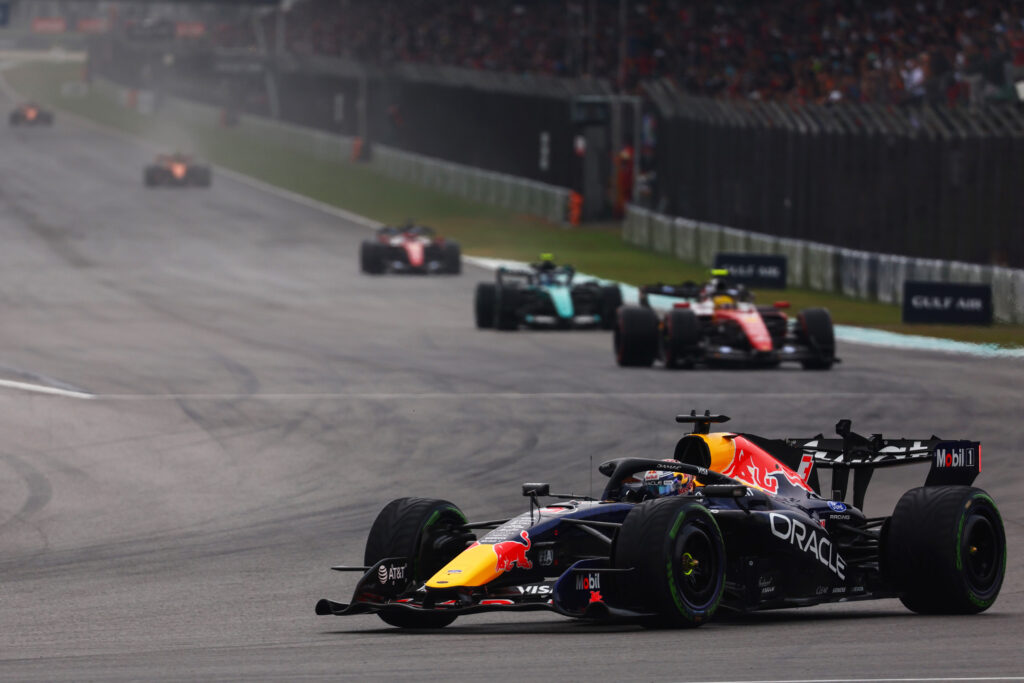
KUALA LUMPUR, MALAYSIA – OCTOBER 04: Max Verstappen of the Netherlands driving the (3) Oracle Red Bull Racing RB22 Red Bull Ford Powertrains leads Liam Lawson of New Zealand driving the (30) Visa Cash App Racing Bulls VCARB 03 RB Ford on track during the F1 Grand Prix of Bahrain in Malaysia at Sepang Circuit on October 04, 2026 in Kuala Lumpur, Malaysia. (Photo by Rudy Carezzevoli/Getty Images) // Getty Images / Red Bull Content Pool // SI202610040283 // Usage for editorial use only //For seasoned veterans like Aston Martin driver Fernando Alonso, the digital drama was practically a non-issue. Because the Aston Martin garage managed to avoid the wet-weather glitch entirely, the two-time champion was completely unfazed by the software panic.
“In our case, last week, the car was fine,” Fernando Alonso shrugged. “So we didn’t suffer any of the issues. So difficult to comment.” He added that the entire grid now expects the problem to be fully understood and resolved moving forward.
To ensure the multi-million-dollar grid doesn’t crash again, the FIA confirmed that the emergency code configuration utilized in Malaysia will remain fully active for the Singapore Grand Prix. A permanent, fully tested wet-weather software patch is scheduled to be released ahead of the United States Grand Prix in Austin later this October.
If you purchase through our Amazon affiliate links, we may receive a small compensation!
755 words
3–5 minutes
F1 Drivers Speak Out After the FIA Finally Explains the Bahrain GP Software Crash
F1 Drivers Speak Out After the FIA Finally Explains the Bahrain GP Software Crash
AMAZON TODAY’S DEALS