
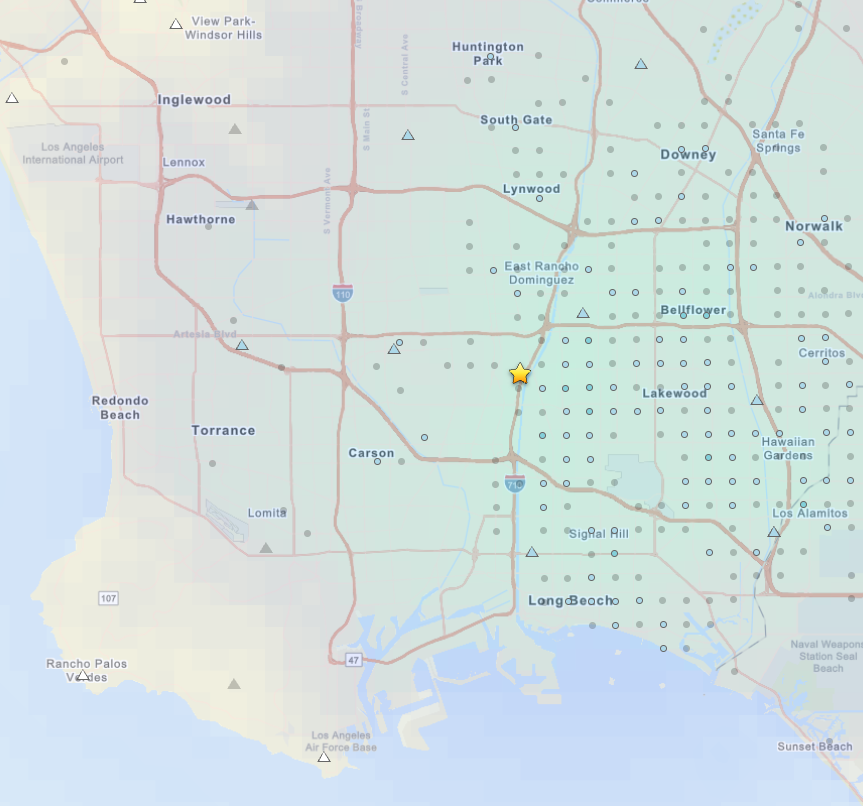
An earthquake briefly shook parts of Los Angeles’s South Bay early Sunday, catching residents off guard overnight.
The U.S. Geological Survey recorded the magnitude 3.2 quake at approximately 12:15 a.m., with its epicenter located 2 miles southeast of Compton.
According to the federal agency, the tremor originated nearly 8 miles below the surface.
While residents across the region felt the midnight shaking, local officials reported no immediate injuries or structural damage.
Despite the lack of immediate impact, the small event reminds Southern Californians of the major fault lines running beneath them.
Scientists warning of a larger catastrophe point to the Cajon Pass corridor, which sits directly above the San Andreas and San Jacinto faults.
The meeting point of these two systems is heavily stressed, with tectonic pressure currently at its highest level in 1,000 years.
Highlighting the vulnerability of the pass, seismic experts describe the junction as an “earthquake gate” that could allow a rupture to tear through both faults simultaneously.
A combined rupture of this magnitude could produce a devastating magnitude 7.5 earthquake across the region.
Warning of the extreme readiness of the massive fault, former U.S. Geological Survey resiliency advisor Ken Hudnut explained, “We all know the San Andreas fault is loaded. It’s ready to go. For years the scientific community has been saying so.”
Reflecting on his personal concern over the vulnerability of the region, Hudnut added, “Cajon Pass keeps me up at night.”
Southern California has already experienced several devastating earthquakes in its recent history.
The deadly 1933 Long Beach earthquake of magnitude 6.4 killed about 120 people, leaving widespread destruction in Compton and Long Beach.
In 1971, the magnitude 6.6 San Fernando earthquake killed 64 people and caused more than $500 million in damage.
Most recently, the 1994 Northridge earthquake of magnitude 6.7 killed 33 people and caused an estimated $40 billion in damage.
This recent overnight tremor serves as another reminder of the seismic threat facing Southern California.