
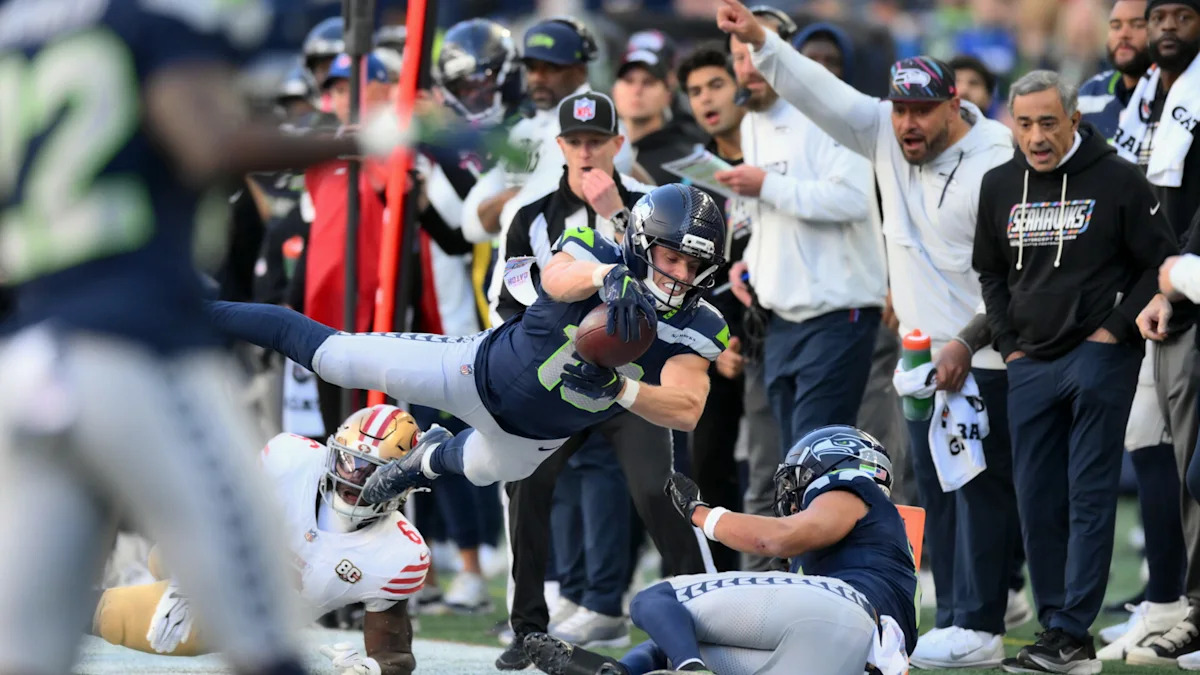
They say football is a game of inches. At a key moment in Sunday’s game in Seattle, it was a game of millimeters.
With the Seahawks facing fourth and 10 from the 50, quarterback Sam Darnold threw a pass to receiver Cooper Kupp, who dove for the line to gain at the sideline.
As explained by NFL V.P. of instant replay Mark Butterworth in a pool report, the proper spot is where the ball is when it breaks the plane of the sideline.
Given the high bar that applies to replay review (“clear and obvious evidence”) it would have been impossible to overturn the ruling on the field. It would have been possible, with comprehensive digital mapping, to know where the ball was in relation to the first-down line when the ball crossed the sideline.
We saw it during the World Cup, with FIFA almost instantly knowing whether a player was offside.
The league currently is able to determine whether a manually spotted ball has made it to the sticks. The NFL has yet to incorporate technology into the ball itself.
Sunday’s situation is a prime example of how technology would have allowed the officials to pinpoint whether the ball did, or didn’t, get as far as it needed to go before the ball went out of bounds.
It’s relatively simple. And the expense is worth it, in the name of getting the calls right.
Hopefully, the NFL will eventually get there. If it already was there, there would be no doubt as to whether the Seahawks did, or didn’t, keep a potential game-tying (or game-winning) drive alive.