
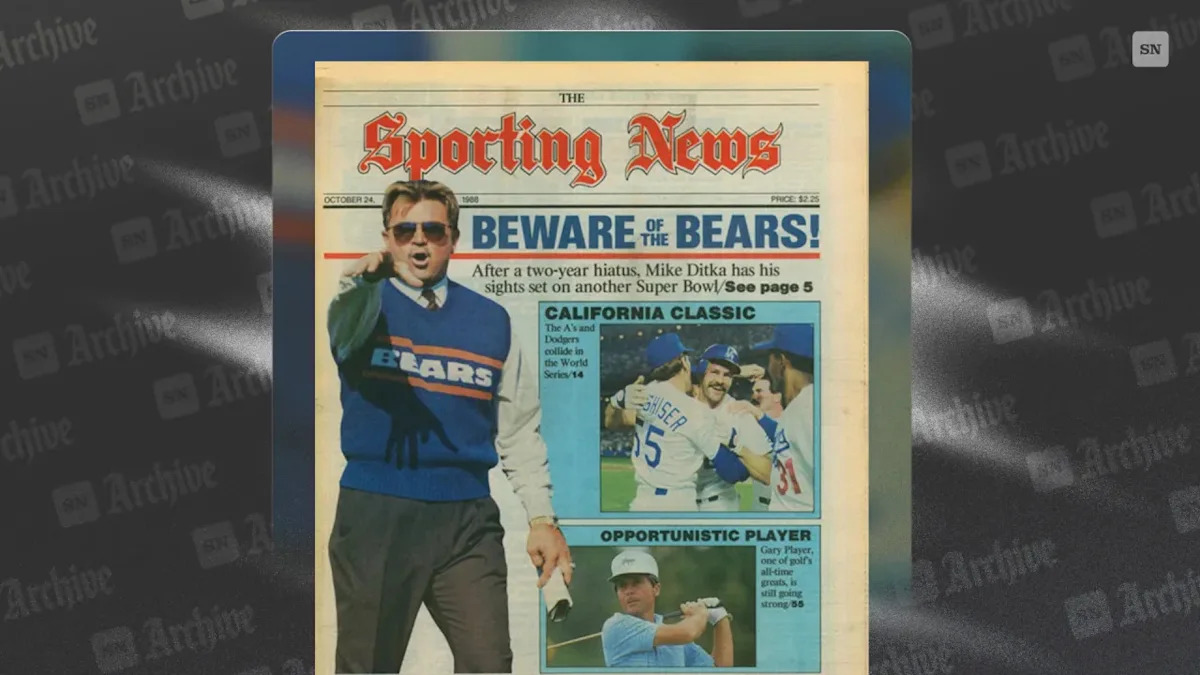
SN Archive (1988): How Mike Ditka reinstilled ‘Bears culture’ as legendary coach got the city to believe again originally appeared on The Sporting News. Add The Sporting News as a Preferred Source by clicking here.
This article, “Bear-able change” by Kevin Lamb, originally appeared in the October 24, 1988 issue of The Sporting News.
CHICAGO— From the beginning of training camp, Coach Mike Ditka called the Chicago Bears a “team in transition.” A rebuilding year smacks of starting from scratch and hoisting a white flag, and the Bears are doing none of that. They still have seven starters who have been in Pro Bowls, including five who were first-round draft picks.
But a year ago, they started 12 Pro Bowl vets and 10 No. 1 picks. They’ve lost seven players with those elite credentials to retirement, injury or better contracts elsewhere. In their place, the Bears have 13 rookies. Two have become starters and five more play regularly in alternating or specialty roles. Is that any way for a team to get back in the thick of Super Bowl contention for the fifth straight year?
“It’s unusual, really, but it’s not unusual, but then, it could be rare,” was Ditka’s answer. There you have it. “It’s surprising that they’re playing so well in spite of all the players they’ve lost,” Buffalo Bills Coach Marv Levy said. “Someone picks up the flag and they keep on marching.”
Bears safety Dave Duerson took a stab at explaining the phenomenon and landed somewhat closer to the heart of the matter. “We had something to prove,” he said, “the way people wrote us off.” Of course, Atlanta and Tampa Bay and San Diego were written off completely, but they didn’t have the foundation of veterans with Super Bowl rings who remembered how to go about winning a championship.
SN ARCHIVES:Access every SN issue since 1886, for free
Those veterans have made the Bears Exhibit A for all the coaches’ hackneyed preachings about hard work and teamwork. It’s as if mothers could actually hand their children a newspaper clipping about a kid who caught pneumonia because he didn’t wear a jacket.
By losing players, the Bears have regained their winning attitude. They’re having fun again. Despite a surplus of talent, they went about their work the past two years unsmilingly, burdened with the grim resignation of workers on an assembly line. The enthusiasm that had propelled them on their merry, marauding joy ride to the championship in 1985 was missing.
That was their edge back then, even more than superior talent. Ditka created such a family atmosphere that you’d have thought the Bears used wood-paneled station wagons instead of a team bus. The return of that one-for-all feeling is the reason defensive tackle Dan Hampton has said all season that this is the best team he has played on.
“I just don’t think anybody cares who gets credit anymore,” Ditka said. “I just think they play and go out and do what we ask them to. I really haven’t heard anyone mention the Pro Bowl. That was a rapid, running current around this team for a couple years.
“I think everybody realized when we won it in ’85, we won it because we were a good team, not because we had one or two great players. We always had one or two great players, but we won because we put the team concept ahead of everything. I think the guys are willing to go back to the team concept now instead of worrying about balancing their checkbooks during team meetings.”
They understand they’ve got no choice, middle linebacker Mike Singletary said. “When you have a lot of talent, you say, ‘We can beat anybody.’ Sometimes you forget the small things. When some of that talent leaves, you look around and say, ‘Hey, we can’t afford to make any mistakes.’ It makes you realize you have to kick and scratch and do whatever it takes.”
At 10 positions, the Bears’ starters this year are different from the primary starters last year. They’ve lost Walter Payton at halfback, Jimbo Covert at left tackle, Willie Gault at wide receiver, William Perry on the defensive line, Wilber Marshall and Otis Wilson at outside linebacker, and Todd Bell and Gary Fencik, who shared time alongside Duerson, at safety. You have the beginnings of a pretty good team with the players they’ve lost.
But players can be replaced. One thing the Bears didn’t lose, said Singletary, was their character.
“Once you build character on a particular team,” Singletary said, “that character’s never going to leave because of the associations between the guys. Neal Anderson may not have the same character as Walter Payton, but there are certain things he saw in Walter Payton that he’s going to assimilate within himself.”
After six weeks, the Bears had the league’s No. 2 rushing offense. Anderson and Thomas Sanders, sharing Payton’s old workload on a 70-30 ratio, were averaging close to 100 yards a game between them. The running game is still enough of a threat to set up play-action passes. It still controls the ball to the extent that the Bears’ defense spent more than 23 minutes on the field in only two of the first six games.
They still have the league’s stingiest defense. After six games, they led the league in average yards, average rushing yards and total points allowed. Their yield of 67 points led the second-ranked Minnesota Vikings by 17-nearly a 20 percent margin-and tied the pace of the 1986 Bears, who set a league record for fewest points allowed in a 16-game season (187). Their average yield of 237.3 yards per game was 78 fewer than the 1985 team gave up in its first six games and four fewer than its average for that whole remarkable season. It doesn’t blitz so much anymore, but it’s still a defense that confuses opponents with shifting alignments and abuses opponents with an overpowering four-man pass rush.
They still have Richard Dent, Steve McMichael and Hampton on that front four. “Our guys up front are just unreal,” linebacker Ron Rivera said. “When four guys are putting the pressure on, you really don’t need to blitz.” That leaves more players in coverage, where the pass defenders have gone back to attacking with bump-and-run.
They still have Jim McMahon at quarterback. In fact, when he started against Dallas October 16, it marked the first time in his seven-year career that he had started the Bears’ first seven games. McMahon still thumbs his nose at authority and aims his passes at openings other quarterbacks wouldn’t notice. He doesn’t scramble so much anymore, but he’s also harder to sack.
They still have Singletary quarterbacking the defense. He was leading the team in tackles even though few teams were bothering to beat their heads against the wall with a running game. Buffalo and Detroit kept the ball on the ground for only 23 of 126 plays in successive games. Singletary remains the conscience of the defense, shaking his head about mistakes after another near shutout and proclaiming the defense is at 65 percent efficiency.
They still have the chin-jutting determination that provokes controversy. Who was the first player to challenge the NFL’s drug policy? A Bear, of course. Dent didn’t think he should have to take random tests more than a year after testing positive for traces of marijuana if rookies had only a year of random tests after testing positive at the pre-draft scouting sessions. The league office caved in like a rookie pass blocker.
And they still have Ditka. He finished the Bears’ last two games against NFC Central rivals, Green Bay and Detroit, by ordering bombs after his vanquished opponents prolonged matters with delusionary timeouts. He has battled the independent media over its disloyal predictions almost weekly. “I’m not psychic like some people. I really don’t have that ability to be an expert,” he said. But truth be told, Ditka was not unhappy to see that the Vikings were the consensus pick to win the division.
“That gives me a way to work, lets me work my game,” Ditka said. His best game always has been motivation. Ditka gives the media straw men to construct, points his players at them and says, “Sic ’em.” After Minnesota whipped the Bears, 31-7, September 18 to create a short-lived tie for first place, Ditka announced, “It’s almost a foregone conclusion that we’re going for a wild card right now.” At the same time, he was telling his players this was their chance to prove those naysayers wrong.
MORE: How Mike Ditka became a full-fledged pop culture icon
Ditka’s motivational shtick has more of an impact on younger players, so he wasn’t heartbroken about keeping so many rookies this year, or the loss of Marshall’s dour presence for two first-round draft picks. The 1985 championship team, remember, was the youngest in the league. By last January, when the Bears lost their second straight first-round playoff game, they were fast becoming the league’s oldest underachievers. The team had settled into static complacency. Several reserves were ready for more playing time. The time was right for a roster transfusion.
After all, the key to staying on top is making changes before they’re obviously necessary. Ditka did that so well that the team actually improved, or stayed even, at most of the 10 positions that changed starters. And by salvaging draft picks for Marshall and Gault who were comparable to their original prices, the front office effectively procured the first halves of two excellent careers for free. Two first-round picks this year and three more next year will enable the transition to continue at a high level.
Taking the changes one by one, the Bears clearly got the worst of it only at left tackle, right linebacker and, now that Shaun Gayle is out for the season with a cracked neck bone, free safety. Even at left tackle, though, second-year player John Wojciechowski may be no Covert, but he has been one of the team’s best blockers.
Marshall’s replacement at right linebacker was Jim Morrissey, a reliable young veteran. But Morrissey’s knee sprain forced two rookies—Mickey Pruitt and, against Dallas’ better running team, Dante Jones—into action.
At free safety, Singletary called Gayle a faster Fencik, with comparable intelligence and toughness. Gayle’s promotion also enabled Duerson to return to his better position, strong safety, after moving last year when the coaches chose Bell over Fencik. The new combination strengthened the team at two positions over 1987, but Gayle’s injury left the free safety job to another rookie, raw but promising David Tate.
MORE: Mike Ditka was every bit as respected by rivals as he was by fans
Halfback and fullback were another double switch. Anderson probably will never have Payton’s sustained excellence, but last year’s offense featured Payton at the end of his career alongside Anderson as an out-of-position fullback. The pairing of Anderson with Matt Subey, a true blocking back, is an improvement.
Gault was replaced on the depth chart by Dennis Gentry and on the roster by Wendell Davis. Ditka has said, trying not to disparage Gault, that the wide receivers are better this year. With Dennis McKinnon and Ron Morris on the other side, the Bears can attack with alternating platoons of wideouts.
Rivera replaced Wilson at left linebacker. He may not be the overwhelming pass rusher Wilson is, but after six games he already had more interceptions (two) than all the other linebackers had last year. Like Gayle and Al Harris, Rivera wasn’t a reserve forced into action so much as an extra starter who finally got a position.
The defense made another combination change by moving Hampton from left end back to right tackle, where he excelled before Perry arrived in 1985. Harris isn’t a big dropoff from Perry at end and he’s a better pass rusher. Hampton’s reunion with McMichael at tackle creates inside pressure that has taken away the quick passes that so often burned the Bears last season.
“The center doesn’t know who to pick up,” McMichael said. “Both of us are going to collapse the pocket. He’s going to have to turn one way or the other.”
The Bears have made less tangible changes, too. Greg Landry, a former quarterback who coaches quarterbacks and receivers, is calling the plays. Those plays include more quick passes to protect McMahon from the league’s ever-increasing barrage of pass rushers. And Ditka decided to return to the 1985 practice of passing out of the starting blocks when the Bears beat previously undefeated Buffalo, 24-3, October 2. That was the old formula: Get a quick lead, turn loose the pass rushers and pile it on.
“I think it helped Jim to go out and throw the ball early with some play-action passes,” Ditka said, “instead of saying, ‘Oh boy, if we get behind, we’re going to drop back and throw it.’ I think we’ve got to attack people with our offense instead of saying, ‘We’re running the ball good, so that means we’ll run it 50 times.’”
MORE: NFL mourns Mike Ditka’s passing
The defense has been hit hardest by the transition, but the players have shown they weren’t just paying lip service when they kept muttering how dangerous they’d be when they finally mastered defensive coordinator Vince Tobin’s system. Their shifts and disguises frustrated Miami quarterback Dan Marino so much in a 34-7 loss to Chicago in the season opener that Marino was yelling at his teammates.
“We have the best team concept in the league,” Duerson said. “Our scheme is a lot different than probably most teams. It’s not built for superstar performances. Our system is built on 11 guys playing their roles. If that happens, we’re going to be able to force some big plays.”
In fact, Tobin’s defense appears ideally suited for getting the most out of above-average players, perhaps better than for overwhelming opponents with great players. The parts are more interchangeable.
“Now that we’ve lost so dang many people, it’s almost like old hat to the other players,” Tobin said. “It’s like, ‘So we lost another one. We’ve just got to pick up and play.’ But we need to start getting them back.”
That’s the storm cloud on the horizon. At some point, the Bears might lose one too many players. They also had a disturbing 2-8 slump, going into their October 24 game against San Francisco, in games where their opponent finished above .500 the previous season or, in the case of this year’s games, was currently above .500. That was a 1-8 mark before the Buffalo game, when Tobin said they learned they couldn’t just flick on a switch and rely on their superior talent.
“We felt confident that if we played well, we’d be successful,” Tobin said, “Yet we also prepared to play well instead of just showing up. We can be successful still, but not just by being physically better, as we’ve been in the past.”
It’s hard to find any team in the NFL that is physically better. As long as the Bears can stay close physically, their edges in emotion and experience might put them over the top. They sure don’t lack for confidence. As McKinnon said after the Vikings lost their second game, “There is no race. As long as we win, the race is over.”