
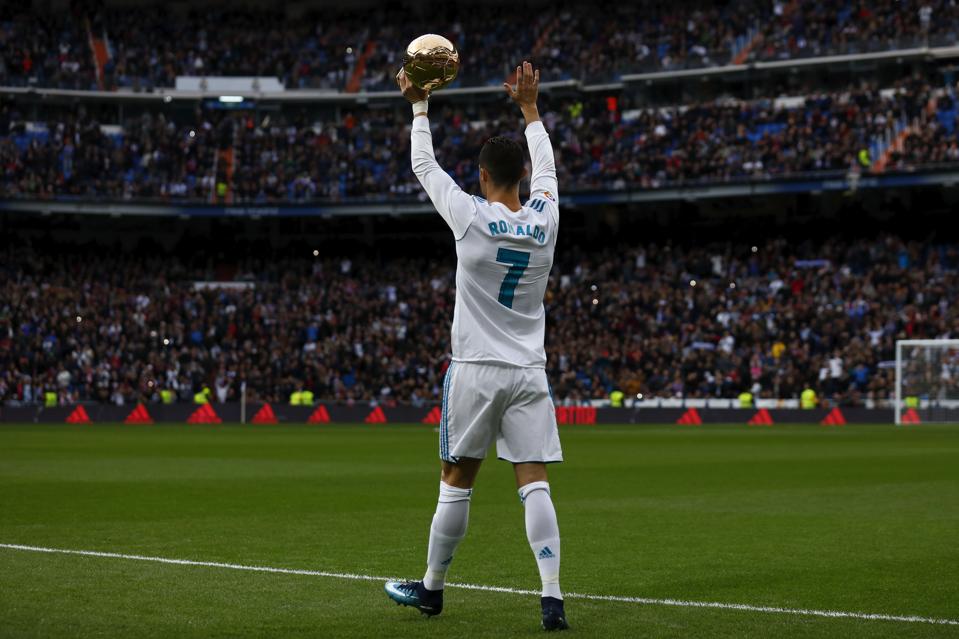
MADRID, SPAIN – DECEMBER 09: Cristiano Ronaldo of Real Madrid CF offers his fifth Golden Ball (Ballon d’Or) trophy to the audience prior to start the La Liga match between Real Madrid CF and Sevilla FC at Estadio Santiago Bernabeu on December 9, 2017 in Madrid, Spain . (Photo by Gonzalo Arroyo Moreno/Getty Images)
Getty Images
Real Madrid players have won the Ballon d’Or 12 times in history as eight different players have taken the award while at the club, from Alfredo Di Stéfano in 1957 to Karim Benzema in 2022.
That record is back in focus this month as the 70th edition will be presented at the London Palladium on Monday, October 26th, the first time the ceremony has been held in London. Four players on France Football’s 30-man shortlist are Real Madrid players, including contender Kylian Mbappé, outside bets Jude Bellingham and Vinícius Júnior, and summer signing Marc Cucurella.
How many Ballon d’Ors has Real Madrid won?
Real Madrid has won the Ballon d’Or 12 times through eight different players, putting the club level with arch rivals Barcelona at the top of the all-time club ranking, with the two clubs accounting for all 24 of La Liga’s wins.
The split between the two is different. Barcelona’s 12 come from six players, and six of those are Lionel Messi’s. Real Madrid’s are spread more widely, with Cristiano Ronaldo the only player to win more than twice at the club. The most recent winner to come from the Spanish capital is Karim Benzema in 2022.
Every Real Madrid Ballon d’Or winner
The first three came during the club’s run of five straight European Cups, and half of the 12 have come since 2013.
Alfredo Di Stéfano (1957, 1959)
Di Stéfano was Real Madrid’s first winner and remains one of only two players to win it more than once at the club. He arrived in 1953 and led the side that won the first five European Cups between 1956 and 1960, scoring in each of those finals.
He was only considered to be eligible once he took up Spanish nationality in 1956, as the award was only open to European players until 1995.
Raymond Kopa (1958)
Kopa joined from Reims in 1956 and won three European Cups with Madrid, and his 1958 award followed a World Cup in Sweden where France finished third and he was named the tournament’s best player. Since 2018, France Football’s award for the best under-21 player has carried his name.
Luís Figo (2000)
Figo won the Ballon d’Or months after crossing from Barcelona to Real Madrid in July 2000 for what was then a world-record fee in one of soccer’s most controversial transfers of all time. Most of the season that earned it was played at Camp Nou, alongside a run to the Euro 2000 semi-finals with Portugal.
Ronaldo Nazário (2002)
Ronaldo joined from Inter at the end of August 2002 and won his second Ballon d’Or months later for what he’d done the previous season. It came after his first with Inter in 1997, as he scored eight goals at the 2002 World Cup, including both of Brazil’s goals in their final victory over Germany.
Fabio Cannavaro (2006)
Cannavaro captained Italy to the 2006 World Cup and joined Real Madrid from Juventus that summer, winning the award for his achievements in Italy before he moved to Spain. To this day, Cannavaro remains the last defender to win the award.
Cristiano Ronaldo (2013, 2014, 2016, 2017)
Cristiano arrived from Manchester United in 2009, having already won the award there in 2008 and his four Ballon d’Or wins for Real Madrid are the most by any player at the club.
The 2013 and 2014 awards came during the period when France Football’s prize was merged with FIFA’s World Player of the Year as the FIFA Ballon d’Or. The 2014 award followed La Décima, Real Madrid’s tenth European Cup, in which he scored a then-record 17 Champions League goals in one campaign. His 2016 and 2017 wins followed back-to-back Champions League titles, with Euro 2016 for Portugal in the first year and La Liga in the second.
Luka Modrić (2018)
Modrić ended a decade in which only Lionel Messi and Cristiano Ronaldo had won the award, with a season in which he won a third straight Champions League with Real Madrid and led Croatia to the World Cup final. The margin was wide as Modrić received 753 points to Cristiano Ronaldo’s 476 in his final year in the Spanish capital before joining Juventus.
Karim Benzema (2022)
Benzema’s award was the first decided on the European season rather than the calendar year, according to the 2022 ceremony record. He led Real Madrid to a Champions League and La Liga double, with knockout-round hat-tricks against Paris Saint-Germain and Chelsea. He received 549 points in the vote, while Thibaut Courtois finished seventh and Vinícius Júnior eighth in the same vote.
The asterisk on three of Real Madrid’s wins
Three of Madrid’s 12 awards were earned largely at other clubs. Figo’s 2000 season was played for Barcelona, Ronaldo’s 2002 case rested on Inter and the World Cup, and Cannavaro’s 2006 season was spent at Juventus.
All three count for Madrid because France Football credits the club a player represents when the award is given. Each had signed for Madrid between the end of the season and the ceremony, although on a strict count of seasons played at the club, Madrid’s total falls to nine.
The near misses
Vinícius Júnior (2024)
Vinícius came closer than any Madrid player since Benzema as he finished second to Manchester City’s Rodri by 41 points, 1,170 to 1,129. His 2023/24 season brought success in La Liga, the Champions League and the Spanish Super Cup, scoring the second goal in the 2-0 Champions League final win over Borussia Dortmund at Wembley, after Dani Carvajal’s opener. Two more Madrid players made the top four as Jude Bellingham finished third with 917 points and Carvajal fourth with 550, but no Real Madrid players or staff attended the ceremony in protest, although Vinícius was named FIFA’s The Best Men’s Player weeks later.
Raúl (2001)
Raúl finished second to Liverpool’s Michael Owen in 2001, with 140 points to Owen’s 176. He received 17 second-place votes from the 51 jurors but only five first-place votes to Owen’s 19. Real Madrid won La Liga in 2000/01, and Raúl finished as the league’s top scorer with 24 goals. The Spanish side also reached the Champions League semi-finals, where they lost to eventual winners Bayern Munich. Owen’s case rested on Liverpool’s UEFA Cup win and two domestic cups, plus a hat-trick in England’s 5-1 win in Germany.
Ferenc Puskás (1960)
Legendary striker Puskás never won the award either, with his best finish being second in 1960, when he received 37 points to the 54 of Barcelona’s Luis Suárez, after ending the 1959/60 season as La Liga’s top scorer. His 1960 included four goals in the European Cup final, as Real Madrid beat Eintracht Frankfurt 7-3 at Hampden Park for a fifth straight title.
Real Madrid Femenino and the Ballon d’Or Féminin
No Real Madrid player has won the Ballon d’Or Féminin. The club’s women’s section was only formed in 2020, two years after France Football introduced the award.
The club’s first nominations came in 2023, when Linda Caicedo, Olga Carmona and Hayley Raso made the 30-player list. Carmona finished sixth after scoring the winning goal for Spain in the World Cup final, with Caicedo ninth and Raso 17th.
Despite Carmona leaving, for Paris Saint-Germain in 2025, this year’s Real Madrid-linked nominee is Caroline Weir for her achievements with Los Blancos last season, although she has since joined OL Lyonnes.
This article was originally published on Forbes.com
If you purchase through our Amazon affiliate links, we may receive a small compensation!
1,205 words
5–8 minutes
Every Real Madrid Ballon D'Or Winner In History
Every Real Madrid Ballon D'Or Winner In History
AMAZON TODAY’S DEALS