
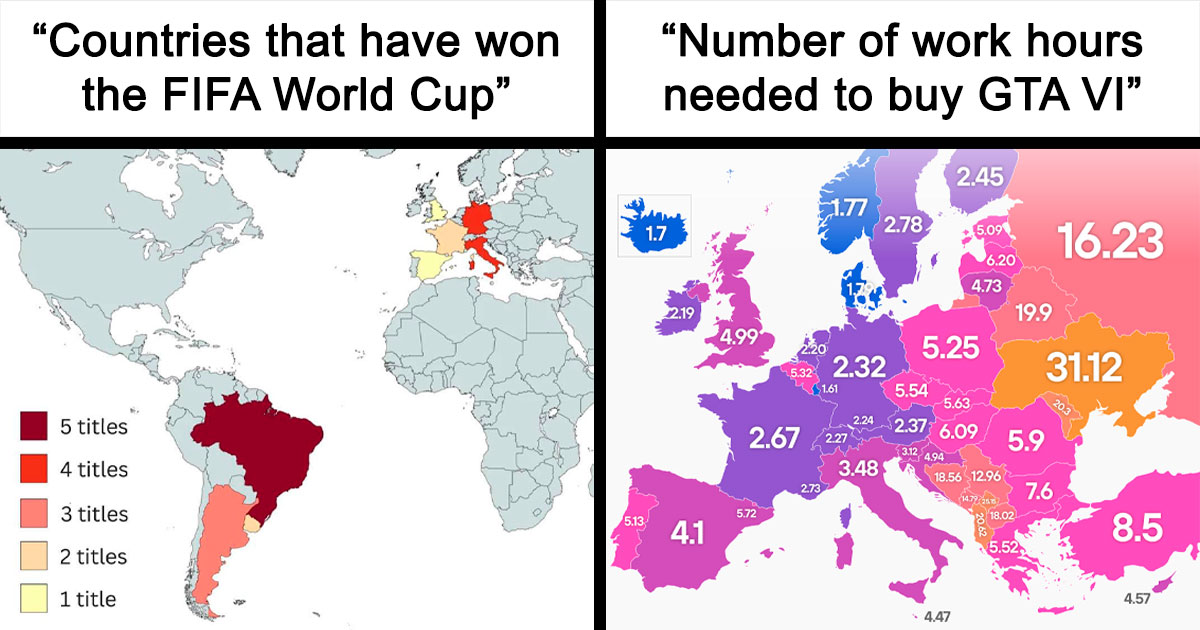
Maps have evolved from ancient clay tablets into essential tools for modern data visualization and spatial analysis.
While often associated with navigation, these visual representations allow people to identify trends and understand information in ways that spreadsheets cannot.
According to “Esri”, maps are more than diagrams that help you navigate from point A to point B.
They offer a method to interpret the world by organizing data through color and geography.
Geography lecturer Philippa Irvine notes that creating a map requires a balance between technical skill and artistic expression.
She explains the process by stating, “The need to marry information with composition and legibility makes it somewhere between science and art.”
Beyond aesthetics, maps are inherently subjective because they involve deliberate choices regarding what information to display.
Geographer Mark Monmonier famously argued that lying with maps is not only easy but essential for utility.
Projections like the Mercator map often distort the size of landmasses to fit a three-dimensional world onto a flat surface.
Irvine emphasizes the importance of critical analysis when viewing these depictions.
She advises that “bias is inherent within maps” and suggests that viewers must always question what is being shown and how it is presented.
Beyond professional cartography, many individuals create maps to explore personal interests or to document their own experiences.
Science journalist Betsy Mason has used map-making as a way to organize her thoughts and imagine new possibilities.
Whether tracking global population density, historical borders, or cultural variations like language, maps continue to shape how society perceives reality.
As the world remains in constant flux, the demand for new ways to visualize data ensures that map-making remains a vital practice.
From simple digital projects to complex geographical studies, these tools remain fundamental to understanding the environment.
Ultimately, maps serve as a bridge between raw information and human understanding.