
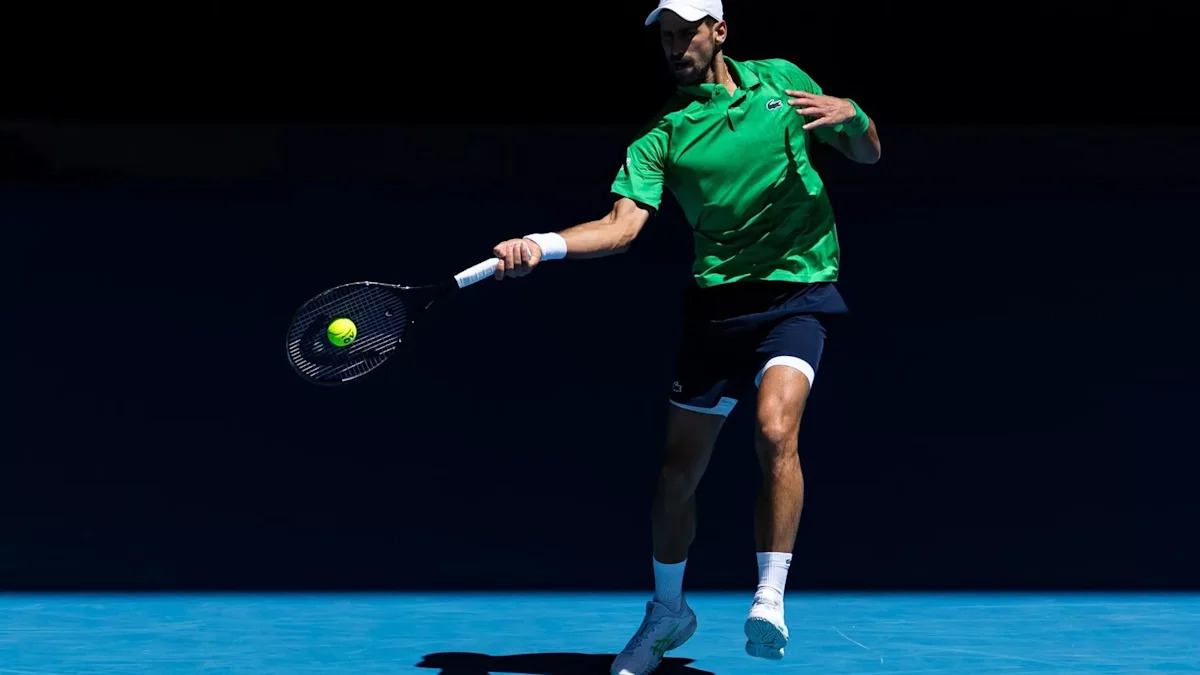
The most impressive shot Novak Djokovic hit in the China Open final might not actually have been the most impressive part of the point, and that’s saying a lot. Alex de Minaur had a break point midway through the first set and, for almost the entire rally, played it exactly as he would have wanted.
He established control, maneuvered Djokovic around the court and twice created an attacking forehand from around his backhand corner. On the second opportunity, de Minaur stepped around the ball and prepared to attack inside-out. Before he made contact, Djokovic was already moving. de Minaur struck the forehand towards Djokovic’s backhand corner, exactly where the Serbian was heading. Djokovic arrived early enough to produce an extraordinary backhand pass and erase what would prove to be de Minaur’s only break point of the match.
The pass was spectacular. But the more interesting question is how Djokovic got there. Because he appears to have known where the ball was going before de Minaur actually hit it.
de Minaur Has a Tell; Djokovic Knew
Let’s start with the mechanics, shall we? de Minaur has a relatively unusual forehand for modern elite tennis. His grip leans towards Eastern rather than the more common Semi-Western configurations seen across much of the men’s tour.
Find Your Qualified Amazon Prime Trial
Select your category below to unlock your specific free trial and discounted membership rate:
Prime for Young Adults
Included with Prime for Young Adults:
- Fast, Free Delivery: Unlimited Same-Day, One-Day, and Two-Day Delivery on millions of items.
- Unlimited Streaming: Prime Video with award-winning Originals, movies, and live sports.
- $0 Food Delivery Fees: Free Grubhub+ membership included (save ~$120/year).
Amazon Prime (Standard)
Included with Amazon Prime:
- Fast, Free Delivery: Unlimited Same-Day, One-Day, and Two-Day shipping options.
- Instant Entertainment: Award-winning TV shows, movies, music, and photo storage.
- Full Access to Alexa+: AI assistant for entertainment, deals, and smart home tracking.
Amazon Prime Access
- Full Prime Benefits: Free shipping, Prime Video, and exclusive shopping deals.
- No Long-Term Commitment: Cancel or pause membership anytime.
That matters because grips influence which racket paths and contact positions feel most natural. An Eastern forehand generally makes driving through the ball and flattening the trajectory relatively comfortable, while a more extreme grip tends to facilitate greater vertical racket movement and topspin.
de Minaur has built an extremely effective stroke around those specifics. He takes the ball early, redirects pace brilliantly and uses depth rather than overwhelming spin to deny opponents time. It is one reason his forehand has improved so dramatically from the shot opponents once routinely targeted.
But technique does not only determine what a player does well. It can also influence what that player prefers to do. When de Minaur moves around his backhand and sets up this particular forehand, the inside-out direction comes naturally. Turning the same ball inside-in requires a different relationship between his body, contact point, and racket path. He can obviously hit both.
How often he chooses one or the other is the tell. According to the directional data behind this particular analysis, roughly 70% of de Minaur’s forehands from these positions travel inside-out. At a recreational level, that might be mildly interesting, but against Novak Djokovic, it becomes intelligence.
Djokovic Isn’t Guessing
We often describe Djokovic’s movement as though everything happens after his opponent strikes the ball. He has amazing reactions, incredible speed, and extraordinary defense. All true. But the greatest returners and defenders do something even more valuable.
They reduce how much reacting is necessary. Consider everything Djokovic knows before de Minaur strikes that forehand. He knows where de Minaur is standing and where the incoming ball is traveling. Then he knows the grip and reads the shoulder rotation. He knows the score. And, whether through statistical preparation or thousands of hours of experience, he knows where de Minaur usually sends this particular shot.
Suddenly the court is not 50-50. If approximately seven out of ten comparable forehands travel inside-out, Djokovic does not need certainty. Watch the point again, and that is what makes it fascinating. Before de Minaur makes contact, Djokovic split-steps and leans toward his backhand corner. By the time the ball actually leaves de Minaur’s racket, the process of reaching it has already started.
Calling that anticipation almost undersells it. It’s pretty obviously prediction. And prediction is one of the hidden advantages separating truly exceptional defenders from merely quick ones. An average player sees where the ball went and runs, but Djokovic begins solving where the ball will go from the information available before impact. That gives him fractions of a second. At this level, fractions of a second are enormous.
Technique Eventually Becomes Strategy
This also offers a broader lesson about professional tennis. Players do not choose tactics independently of their mechanics because technique limits and encourages tactical decisions. A player’s grip makes certain directions easier, their swing path makes certain heights more comfortable, and their movement determines which positions they want to attack from. Eventually those preferences become patterns.
And patterns can be studied. The better a shot becomes, the more interesting this gets. de Minaur’s forehand is no longer an obvious weakness, far from it. His ability to take the ball early and drive it deep has become a foundation of his rise.
But against the very best opponents, even a strength can contain information. If de Minaur repeatedly trusts the inside-out forehand because it is one of his safest and most effective attacking patterns, opponents can begin expecting it. Most players still cannot do very much about that, but Djokovic can.
Pressure may reinforce those tendencies too. On an ordinary point, a player might be more willing to attempt the lower-percentage direction. On break point, with an opportunity to take control of a final, returning to the stroke pattern you trust most is perfectly rational.
Djokovic knows that as well. So de Minaur gets the forehand he wants. Djokovic gets the information he wants. And suddenly they are both moving towards the same corner. Djokovic eventually won the opening set 7-6, having saved that lone break point, before de Minaur retired early in the second with a groin injury. In a set without a single break of serve, that point becomes even more significant.
The Last Word
The backhand pass will naturally get the attention as it should. It was brilliant, but Djokovic’s ability to hit it began several moments earlier. de Minaur’s technique created a preference. Repetition turned that preference into a pattern. Djokovic recognized the pattern and started moving before the shot was even struck.
That is simply elite anticipation. The spectacular remains Djokovic making that shot. The fascinating part remains that, before de Minaur hit the forehand, he already seemed to know where he needed to be.
Main Photo Credit: Mike Frey – Imagn Images