
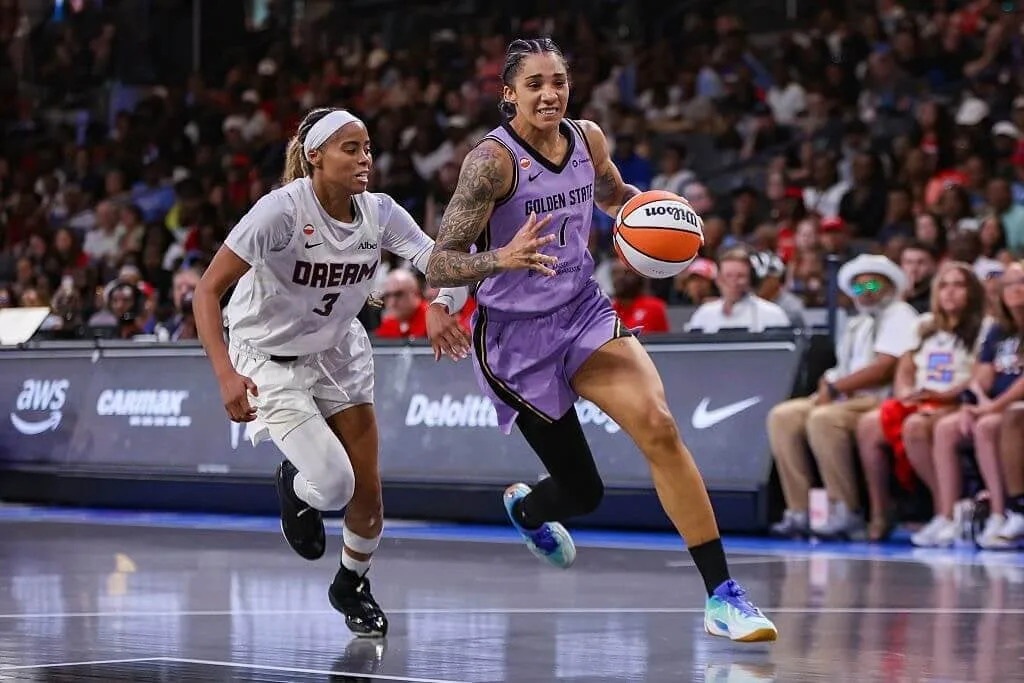
The WNBA Finals will feature a first-time champion as the Golden State Valkyries and Atlanta Dream face off in what should be a defensive masterclass. The best-of-seven series begins on Saturday and can be seen on NBC/Peacock.
Golden State swept this series during the regular season, but the teams played three times over an 11-day period in the first half of the season. Only one of those games was decided by double digits, and both teams have grown significantly since.
|
Game |
Away team |
Home team |
Date |
Network |
|
Game 1 |
Atlanta Dream |
Golden State Valkyries |
Saturday, 3:30 p.m. |
NBC, Peacock |
|
Game 2 |
Atlanta Dream |
Golden State Valkyries |
Monday, 8 p.m. |
USA, Peacock, CNBC |
|
Game 3 |
Golden State Valkyries |
Atlanta Dream |
Thursday, 8 p.m. |
USA, Peacock, CNBC |
|
Game 4 |
Golden State Valkyries |
Atlanta Dream |
Saturday, 3:30 p.m. |
NBC, Peacock |
|
Game 5 * |
Atlanta Dream |
Golden State Valkyries |
Mon., Oct. 26, 8 p.m. |
USA, Peacock, CNBC |
|
Game 6 * |
Golden State Valkyries |
Atlanta Dream |
Thur., Oct. 29, 8 p.m. |
USA, Peacock, CNBC |
|
Game 7 * |
Atlanta Dream |
Golden State Valkyries |
Sat., Oct. 31, 8 p.m. |
USA, Peacock, CNBC |
Here are the biggest storylines to watch:
Can the Valkyries cap their meteoric rise with a championship?
Since joining the WNBA last season, Golden State has led the league in several areas — attendance, general arena vibes and revenue (just to name a few). In the Valkyries’ freshman season, they made the postseason, which was a major achievement for an expansion team and the first time that had happened in the WNBA. Now, the stakes are higher and the Valkyries — with all of their financial success as the first women’s sports franchise valued at $1 billion — have a chance to back up all of that with a title.
The only sports franchise to win a title in its second season of existence in the last 50 years was Atlanta United, which won the MLS crown in 2018 after joining the league in 2017. The slight difference here was that Atlanta United started in 2014, so while 2018 was their second season at the MLS level, the club had a longer runway. The Valkyries didn’t even have their general manager in place until a year before the team took the court. Natalie Nakase wasn’t hired as head coach until seven months before their first game. The ramp up was faster, and the fact that the Valkyries are now in the finals in their second season is an incredible accomplishment, but they certainly aren’t satisfied with just a finals appearance.
Will Allisha Gray return?
Through the regular season, four-time WNBA All-Star Allisha Gray led the Dream in scoring (22 points per game), but in the first half of Game 1 of the semifinals against the New York Liberty, Gray injured her left shooting hand and was ruled out. At the time, New York had a three-point lead heading into the second half, and her absence looked like a possible unfortunate trigger for New York’s continued rise. Instead, through the next five halves of basketball, Atlanta adjusted its lineups, controlled the games and swept the Liberty. Though Atlanta hasn’t provided a diagnosis for Gray, she was considered day-to-day and went through some warmups before Game 3 before being ruled out.
With the extended break between the semifinals and finals, Gray should be available for Atlanta. How she incorporates herself back into a team that has been rolling will be interesting to see, and it’s another wrinkle for Golden State to plan against. The Valkyries have not played against Atlanta since it added DeWanna Bonner, and there’s really no film available on what to expect from the Dream with both Gray and Bonner.
Williams, Reese roll with postseason up-my-game competition
The postseason is made for gamers, and this matchup features two of the best. Golden State guard Gabby Williams has long been known as one of the best two-way players in the league and was an All-Star the last two seasons. But especially this year, after joining the Valkyries in free agency, she’s considered a player with the caliber to be a franchise star. In the Bay Area, she has been just that. Even more impressively, she has taken her game to a new level as she hunts the championship crown. Her overall shooting percentage and 3-point percentage have both increased by at least five percent in the playoffs while her averages in almost every other category also increased significantly — scoring (up nine points per game), assists (doubled from two to four per game) and free-throw shooting (from 74 to 92 percent).
Not to be outdone, forward Angel Reese, in her first year with the Dream, has also upped her game in this postseason race. Upon arriving in Atlanta, coach Karl Smesko made the decision to change Reese’s shot, which resulted in some growing pains, but he was confident that by the postseason, her shooting would be strong enough to make opponents respect her outside shot, and if they didn’t, that she could make them pay. Reese’s biggest jumps in the postseason have come in her 3-point shooting percentage (doubling from 19 percent to 38 percent) and in her free-throw shooting, where she has hit multiple clutch shots, going from 72 percent to 87 percent.
Bonner’s title hunt continues
Bonner joined the Dream with five games left in the regular season after a simpatico exit with the Phoenix Mercury. After playing the majority of her 17-year career there, they released her from her contract after being booted from playoff contention so she could hunt a title elsewhere — in what could be her final WNBA season. After failing to get her to sign during free agency the last two years, the Dream finally got Bonner aboard for this run, and she has been crucial. Beyond contributing in Gray’s absence, her veteran leadership and voice — no player in the history of the WNBA has more playoff experience than Bonner — have been necessary for the Dream to this point.
The undercurrent of this feel-good storyline is that almost everyone expects some kind of response by the league and owners after this season (and those calls will certainly become louder if Atlanta wins) that would disallow a move like this going forward. While this decision might let Bonner ride off into the retirement sunset with her third title, it’s not hard to imagine that some owners might not love the idea of stacking rosters just games before the playoffs. So, enjoy it now, because the implementation of the “Bonner Rule” seems unavoidable.
Where will Atlanta’s home games be?
Atlanta’s “home” arena is still in question for the finals. The franchise announced during the semifinals that in 2027 it would be moving from the Gateway Center, a 3,500-seat arena outside of Atlanta, where the Dream have played most home games over the past six seasons, to State Farm Center. While the team moved its playoff games to State Farm for the first round and semifinals, the arena is booked for all three potential Dream home games in the finals (one for a concert, two for Hawks’ NBA games). This means Atlanta will be left searching for a different venue since it needs to seat more fans than Gateway can host. It almost certainly won’t find one with finals vibes. To stay as close physically to downtown Atlanta as possible, the Dream are likely to play their finals games at Georgia Tech, which has an arena that seats — at most — about 10,000. It wouldn’t be ideal, but unless there’s some solution with State Farm, it’s hard to see another fix that puts the team as central as possible.
Given that both Atlanta and Golden State are coming off finals-clinching games in hostile environments, it’s clear both teams have shown the ability to steal games elsewhere. The Valkyries’ Balhalla, even in its second season, has become the benchmark for basketball environments in the league. Could a cobbled-together Dream “home” event become the same for Atlanta? We’ll see.
Defensive masterclass in session
The Valkyries had the best defensive rating during the regular season, while the Dream have had the best defensive rating through the postseason. The Valkyries gave up the fewest points in the paint, while the Dream gave up the fewest second-chance points. All in all, it’s fair to expect this series to be one in which defenses show up and shine.
Valkyries’ best asset: Through the playoffs, Golden State has given up fewer than three fastbreak points per game. That’s partially due to the fact that the Valks have been shooting well and not turning the ball over much, but overall, this is a defense that gets back and doesn’t allow opponents to capitalize on mistakes. The way this squad rebounds, on both ends, just means the Valks are having a chance to get set up on defense a lot of the time.
Dream’s best asset: When Reese said she was going to have Jordin Canada and Rhyne Howard’s names engraved on her Defensive Player of the Year trophy, it made a lot of sense. This trio has been the focal point of the most active defense in the league this year, when it comes to takeaways. In the postseason, they’ve been even better. In the playoffs, Atlanta is averaging more than 10 steals a game and turning opponents over more than 18 times per game. The Valkyries averaged the fewest turnovers per game during the regular season, but the Dream’s improvement in the postseason — plus the addition of Bonner — makes Atlanta’s defense fiercer now than when the teams met during the regular season.
This article originally appeared in The Athletic.
Atlanta Dream, Golden State Valkyries, WNBA
2026 The Athletic Media Company