
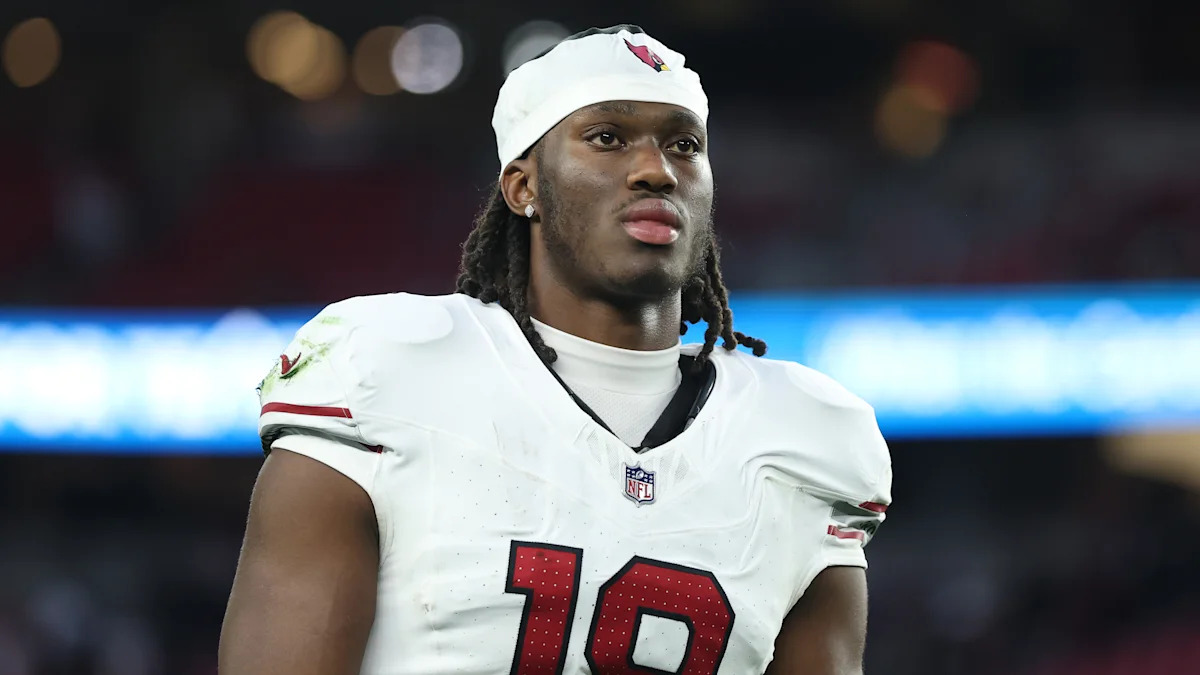
The Marvin Harrison Jr. trade to the Texans was confirmed by DeMeco Ryans himself after the team’s blowout win against the Titans. Houston is sending a 2027 second-round pick (currently 39th overall) for Harrison, with Arizona also moving up from the seventh round to the sixth round in a pick swap in the 2027 NFL Draft.
Here are the WRs to be drafted in the second round in the last three classes for reference: De’Zhaun Stribling, Denzel Boston, Germie Bernard, Jayden Higgins, Luther Burden, Tre Harris, Jack Bech, Keon Coleman, Ladd McConkey, Ja’Lynn Polk and Adonai Mitchell.
Harrison may not be the very best of this group moving forward, but he’s certainly better than many of them. Ultimately, the trade compensation is within the range of normal, even if there are very clear pros and cons to his game. I wrote about them extensively over the weekend as well as the fantasy fallout for the Arizona Cardinals. Now, let’s dive into the fantasy ramifications for his new team.
Texans Fantasy Fallout
The Texans absolutely should be a pass-first team. If we stacked every team’s offensive success rate on passing and rushing plays, the Texans are 13th in passing and 63rd out of 64 units rushing, only ahead of Browns’ run plays. This isn’t a new problem either. It’s been the worst rushing team since CJ Stroud and DeMeco Ryans have been together. A David Montgomery groin injury should unlock Woody Marks to some degree, but the RB and OL talent are nowhere near fixable in 2026 when the Texans are fighting off a 1-4 start with a clear-cut contender in their division.
Stroud can handle a pass-first offense, at least when Nico Collins is healthy. Stroud’s +0.16 EPA per play with Collins on the field is QB5, only trailing Jared Goff, Josh Allen, Brock Purdy and Dak Prescott. When Harrison takes snaps away from Xavier Hutchinson and Kayshon Boutte, then they can become even more potent. They are also clearly better when 2025 third-round slot WR Jaylin Noel is playing the appropriate amount of snaps.
Collins is half PPR’s per-game WR4 on WR8 usage. His 105 air yards are WR9 and give him long-TD ability, and he’s easily the top red-zone threat on the team. The downfield role is unlikely to change for him with Harrison Jr. around. Collins will likely eat the most snaps at X receiver, which typically means a well-rounded but vertical-built route tree. The Cardinals tried Harrison in that exact role, and it straight-up failed due to a lack of speed. Collins is one of the rare WRs who can be given the most difficult route assignments and still produce like one of the best. If there’s an area of the field that could get a bit squeezed with Harrison around, it’s in the red zone, as his big frame could be viewed as a first-read asset. It’s enough to knock Collins down a hair in rest-of-season rankings — I’d take Collins WR10 if drafting today — but this should not be viewed as a 1A/1B situation. Collins is simply on another planet in terms of talent and efficiency:

Harrison will be significantly better on the Texans than he was over his last 10 games with the Cardinals, when he was the WR51 on WR40 usage. His -12% completion percentage over expected was 76th out of 87 qualifiers, largely due to his own issues but also partially because of QB play. Stroud is the way better version of Jacoby Brissett, and this role as the primary Z receiver in Houston will be way better for his own skillset than being the downfield X receiver in Arizona. There will be more shallow and intermediate breaking routes, bunched sets, at-snap motions, slot work and other ways to hide his speed-based limitations. Stroud also knows Harrison well from their time together at Ohio State, so this chemistry should be established quickly.

While the per-target results should be better, Harrison must completely ice Hutchinson and Boutte for snaps to be an upside WR4 in fantasy. The Texans were rotating their WRs before this trade, and that simply can’t happen. In the three games with Collins, target shares were Collins (26%), Hutchinson (17%), Boutte (11%) and Noel (10%). Hutchinson’s expected half PPR points in that role equated to the WR51 per my model, so Harrison has to at least have the Hutchinson role to be relevant. That’s not a high bar to clear, but the coaching staff can’t continue to mix in the other boundary receivers at the expense of Harrison. For now, Harrison is a quality bench stash who will be better in November and December than right away. He’d be in the Jordan Addison, Dontayvion Wicks and Romeo Doubs tier for my rest-of-season ranking as a WR4/5. That’s way better than what he would’ve been rotting away in the desert. He was the worst 6th- or 7th-round pick in fantasy this year:

There is obviously no room for anyone else in the WR room. Noel should slide into 3-WR sets as the primary slot, while Hutchinson and Boutte become extremely small parts of the rotation as insurance or run-game options. Dalton Schultz will have more relevance than them, but Schultz is the TE18 on TE12 usage in games with Collins since 2025. Introducing another red-zone threat to the team should send him to very clear TE2 land.
Montgomery (groin) “may miss some time” per Ryans, so it should be more Marks than usual. This trade shouldn’t really impact the running back position much. They might run a little less with this 3-WR set, but they will also move the ball better, giving the team more red-zone chances. It’ll all even out. How Marks and Montgomery fare will largely be dependent on if one can separate from the other. To my eyes, it’s not close. Marks is better. He’s also healthier, younger and would fit this more spread style offense, if that’s what is coming.