
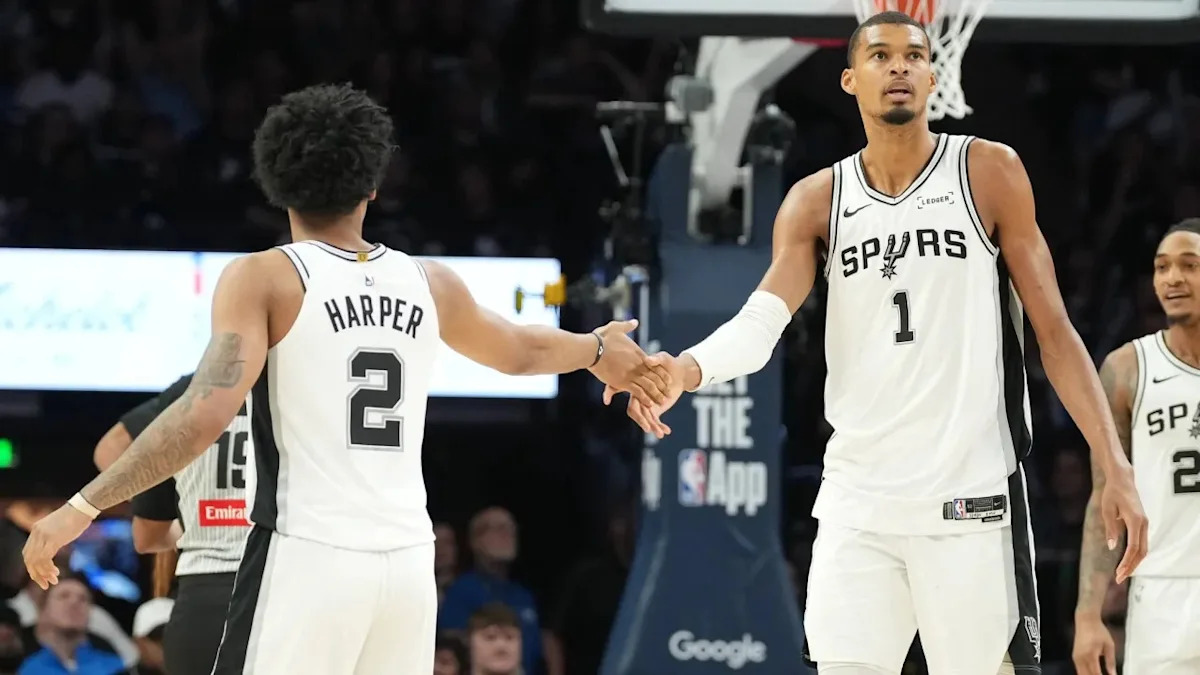
Dylan Harper reveals the main flaw he worked on to help Victor Wembanyama, Spurs originally appeared on The Sporting News. Add The Sporting News as a Preferred Source by clicking here.
Leaps after rookie years are to be expected. However, being Dylan Harper means expectations are much higher than for the average second-year NBA player. Some people in his draft class are just vying for a rotational spot, while a select few struggle to make the starting lineup. The San Antonio Spurs young gun knows that he needs a star-level leap, not just for himself but to help Victor Wembanyama and Co. finally hoist the Larry O’Brien trophy. That is why he worked on one specific flaw in his game this offseason.
Harper unveils one flaw he patched up to help Wembanyama, Spurs get NBA championship
It’s hard to diagnose and dial in on one specific point of improvement after just a single year in the NBA. Players typically use their rookie contracts to figure out what type of player they are and which old habits should die. Dylan Harper does not seem to need that transitionary period. His rookie year with Coach Mitch Johnson and Victor Wembanyama saw him play crucial minutes from the regular season to the NBA Finals.
That is why it’s become easier for Harper to know what he needs to work on over the summer break. So, what was the main thing that the second-year player worked on? It all had to do with being a better perimeter presence for the Spurs, via Jared Weiss of The Athletic.
“I think shooting from the perimeter was a big thing for me. And I think just getting more comfortable with my shot, get more comfortable shooting off the dribble, and just try to be as efficient as I can. And I feel like tonight, the ball just went in,” Harper declared.
Casual NBA fans might not realize Harper struggled from deep during the 2025-26 season. He shot a measly 34.3% from the three-point range, which was way below the league average of 36%. The worrying part was that his shot diet only consisted of 27.13% attempts from outside. This meant the paint got cluttered much more when Harper was shooting. This increases the number of people boxing out Victor Wembanyama and the other Spurs big men, which often leads to poor offensive rebounding.
All of these are just marginal, right? Well, not really. Wembanyama and the Spurs are great at rebounding when they control the interior or linger there for a while. It can be seen in their league-leading 77.3% DRB%. But the same doesn’t hold for their ability to clean the offensive glass. Coach Johnson sees his squad dip to 11th in the NBA in ORB% because of holes in Harper and other Spurs’ shot diet. As a result, they only get a 26.2% ORB%.
Harper becoming a better shooter by intention helps a lot. He will draw more defenders to the perimeter,, which enables the Spurs to get second-chance possessions through offensive rebounding. But has this started to surface? It’s too early to tell, and the sample size of their sole NBA Preseason game against the Atlanta Hawks is insufficient.
However, Harper did well on the perimeter against a wing-heavy, point-of-attack-focused team. Harper went 60% from the three-point line on five attempts. Adding in the fact that he went five-for-seven on the field meant that he also scored 16 points. Importantly, the Spurs grabbed 13 offensive rebounds, which is already higher than the Spurs’ 2025-26 NBA average of 11.4.
This one improvement from Harper has already snowballed into greater yields for the Spurs. His threat from three means his gravity pulls defenders away from Wembanyama for easy box-outs. If Harper knocks down the shot, they get three points. If he doesn’t, they get an easy reset shot clock.