
 There’s a reason they call her the Gold Mamba.
An unconscious shotmaker. Never afraid of the big moment. Nobody catches fire quite like Arike Ogunbowale.
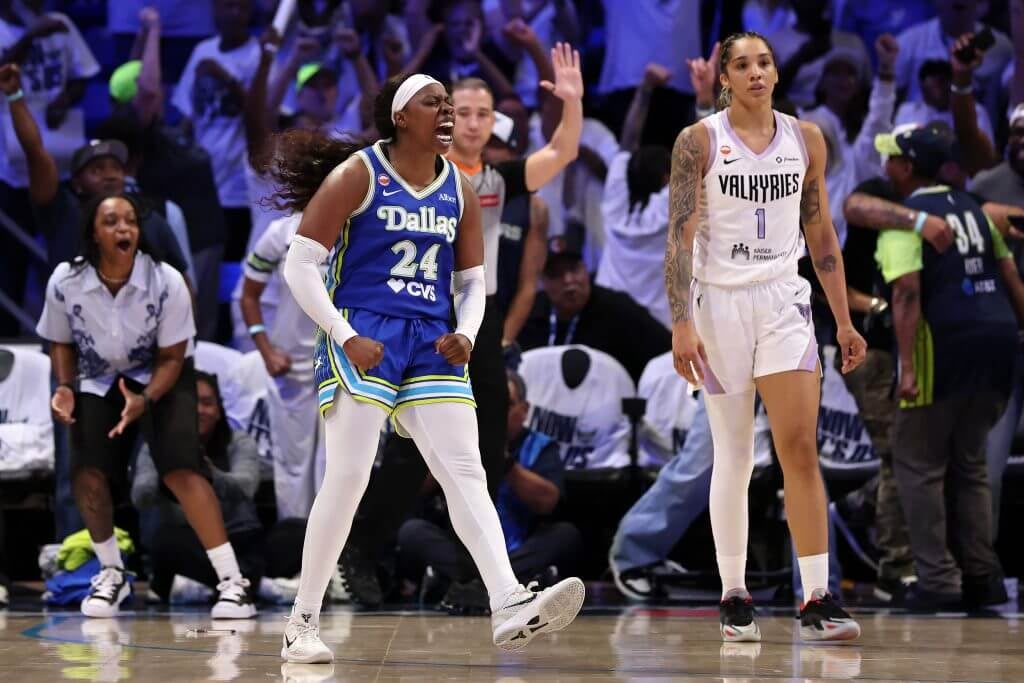
Ogunbowale helped the Dallas Wings stave off elimination on Wednesday night with a playoff-record 45 points, none bigger than the game-tying 3-pointer at the end of regulation — off the dribble, going left, as she does — with Golden State Valkyries forward Gabby Williams blanketing her in the corner. Dallas won 108-100 in overtime at home, forcing a decisive Game 3 on Friday in Golden State.
“I guess I like it when the time is going down,” Ogunbowale said on the ESPN broadcast postgame.
Williams had to be feeling déjà vu watching the former Fighting Irish star hit a late-game jumper, just as she did when Notre Dame beat her UConn Huskies en route to the 2018 national championship.
From there, Ogunbowale’s heater was unrelenting.
She started overtime with a banked 3-pointer, giving Dallas a lead it would not relinquish. After getting into a tussle with Tiffany Hayes (another UConn product, in case this game needed any more spice), Ogunbowale got 6-foot-5 Kiah Stokes — yep, another Husky — on the switch and drained a 3-pointer over the center.
“I can’t even put into words what she just did,” Wings guard Paige Bueckers said. “I’m on the court in awe … An honor to be on the floor with her tonight, she really carried us.”
Bueckers carried the Wings in their playoff opener Sunday, but no one else came along for the ride. After Game 1, Ogunbowale said she didn’t think she was aggressive enough and let the Valkyries dictate what she could do. Dallas head coach Jose Fernandez said the Wings needed the real Arike in Game 2.
She showed up in full force Wednesday, making 12 of 23 field goals and 16 of 18 free throws. Golden State does well to stifle ball movement and off-ball actions, but Ogunbowale was a blunt force in isolation: crossovers, step-backs, blow-bys into the paint.
The individual brilliance was too much for even the Valkyries, a team full of all-defense players, to contain.
That’s the formula for the Wings going forward. Bueckers will command defensive attention, no matter how she shoots from the floor, and her teammates have to exploit those openings. Alysha Clark and Aziaha James were decisive off the catch in Game 2, making their way downhill and taking opportunities from beyond the arc to combine for 34 points off the bench.
Ogunbowale probably won’t get 45 again, but Bueckers won’t be limited to 10, either. In two games, they’ve effectively solved Golden State’s defense, and their shotmaking is more reliable than the Valkyries in a high-scoring contest.
Trading baskets favors the Wings, not the higher seed.
Bueckers joked at the end of Game 1, after Golden State had won 104-80 in commanding fashion, that Valkyries head coach Natalie Nakase couldn’t have been happy to see her team surrender 80 points. That sentiment carried through Wednesday. Even with the Valkyries heading home and being favored to advance, the series has been played on Dallas’ terms.
The finale will at least be played on Golden State’s home court, the lone advantage left for the Valkyries after a dominant regular season and sweep over the Wings in their three regular-season meetings. Dallas has fought to keep its season alive, battling through injuries to 2026 No. 1 pick Azzi Fudd, then Alanna Smith, and even Awak Kuier in Game 2’s crunch time.
The Wings just needed a little magic, and Ogunbowale provided it.
Atlanta finally bucks trend of first-round losses
The hardest game in any series is the close-out game, and it’s the one this current Atlanta Dream core hadn’t yet figured out how to win.
Facing a boisterous Washington Mystics home crowd and dealing with a tight whistle and foul trouble for Rhyne Howard and Angel Reese, the conditions were ripe for an upset by the lower seed to force a winner-takes-all game in Atlanta. Instead, with two All-Stars on limited minutes, the Dream turned to a third.
Allisha Gray, the team’s seasoned shooting guard, was the steadying force Atlanta needed to keep Washington at bay and led the Dream to the semifinals for the first time since 2018 with a 93-75 first-round WNBA playoff win.
Gray, playing her 10th season at 31 years old, finished with a team-high 22 points and four steals, adding three assists compared to one turnover. Atlanta built an early lead, and every time the Mystics cut into the margin, Gray was there to stem the tide.
She was automatic off of offensive rebounds, attacking the compromised Mystics’ defense on the resets. She scored from distance with three 3-pointers, had her jumper going from the midrange, and consistently got to the rim.
It seemed as if the Mystics forgot she was left-handed, as Gray kept getting to her strong hand on drives to the basket.
Washington cut the deficit to one possession at 65-62 in the fourth quarter. From there, Gray had her fingerprints all over a 13-0 run to re-establish control. She drew two defenders on a two-player action with Naz Hillmon, feeding her for a layup. She stole the ball from Mystics forward Kiki Iriafen on the next possession, spearheading the transition offense and then drawing a charge on Sonia Citron, leading to a Howard jumper.
It was hard for either team to establish a rhythm in a game featuring 53 fouls, but Gray was poised and able to execute throughout. Three straight years of first-round eliminations have given the Dream knowledge of what it takes to succeed in this environment.
They finally had the experience to pull through.
The victory pits them against the No. 8 seed New York Liberty, whom they’ll host Sunday.
What awaits in the semifinals?
The Dream won the season series 2-1 against the Liberty, with each team winning once on the opponent’s home court. Satou Sabally (who is now out) was in the lineup when New York won, and one of Atlanta’s wins was when Breanna Stewart was sidelined.
The Dream won the final two matchups, which closed out the regular season.
The primary advantages both teams enjoyed in their first-round playoff wins won’t be present in this semifinals matchup. The Dream are bigger throughout the lineup than the Minnesota Lynx (whom the Liberty swept in the first round), and Reese will battle Jonquel Jones on the boards better than just about anyone else in the league. Two-time WNBA champion Jordin Canada is also more settled at point guard than Lynx rookie Olivia Miles and has three straight playoff double-doubles.
Atlanta, on the other hand, won’t be able to get out in transition as easily against New York. The Liberty will turn the ball over, but not nearly as much as the Mystics, and their transition defense is far superior.
Expect an offensive series. Five players averaged double-digit scoring for New York (though one was Sabally) during the regular-season games against Atlanta, and six players from the Dream were in double figures. Both teams can get hot from 3-point range; Sabrina Ionescu and Howard have each held the single-season 3-point record at one point. Atlanta has no good matchup for Stewart, but the Dream will make all of New York’s guards work defensively.
How each team uses its bench will be interesting. Both coaches leaned on their starting lineups in the first round, but can they afford to do so in a five-game series that most likely won’t be a sweep?
The Liberty have championship experience, as this core won the title in 2024, albeit under a different coach. The Dream were a better team this season, though that didn’t seem to help Minnesota much.
Young Mystics have verve, not enough depth
Prior to the FIBA break, Iriafen was tired of hearing how young her Mystics squad was.
Yes, the Mystics were the youngest team in the league and the youngest to ever make the postseason.
“We’re over the young. We’re over it,” Iriafen said. “At this point, we feel pretty comfortable playing at this level.”
That may have been true in the regular season, but Washington showed its youth during the postseason.
Shakira Austin wasn’t comfortable being a go-to player against a frenetic Atlanta defense. She got sped up by doubles, had difficulty reading the floor when the second defender came and often missed wide-open teammates. She didn’t have confidence in her 3-point jumper when given space.
Georgia Amoore wasn’t comfortable shooting from distance after making 41.4 percent of her 3s in the second half of the season. Rookie Lauren Betts couldn’t put the ball on the floor.
The entire team failed to value possession and threw the ball all over the gym, whether that gym was State Farm Arena on Sunday (23 turnovers in Game 1) or CareFirst Arena on Wednesday (19 turnovers in Game 2).
Even Mystics coach Sydney Johnson couldn’t find the right buttons to push in his postseason debut as a head coach. The Mystics desperately needed scoring and spacing, but the rotations leaned on defensive specialists, and rotation players who provided important minutes in the regular season were curiously sidelined.
Washington’s All-Stars, Iriafen and Citron (23 and 22 years old, respectively), mostly met the moment. Iriafen dominated the boards and sustained the offense with her putbacks while Citron averaged 25 points in the series, but even they had their foibles taking care of possession and defending without fouling — though everyone was in foul trouble in Game 2.
The Mystics brought their energy, but the discipline wasn’t there. Despite their best efforts, they looked young.
This article originally appeared in The Athletic.
Washington Mystics, Atlanta Dream, Dallas Wings, Golden State Valkyries, WNBA
2026 The Athletic Media Company